


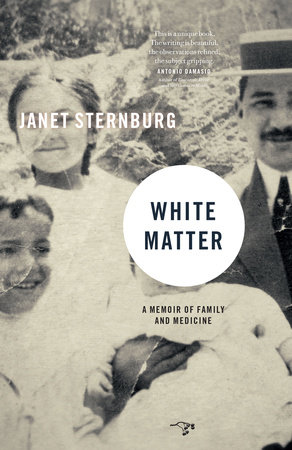

A Memoir of Family and Medicine: White Matter
A Memoir of Family and Medicine
Janet Sternburg
On Sale: 09/15/2015 | $17.95
9780989360494 | Paperback 5-1/2 x 9 | 232 pages
Book Description
White Matter: A Memoir of Family and Medicine is the story of a Bostonian close-knit Jewish working-class family of five sisters and one brother and the impact they and their next generation endured due to the popularization of lobotomy during the 20th century. When Janet Sternburg’s grandfather abandoned his family, and her uncle, Bennie, became increasing mentally ill, Sternburg’s mother and aunts had to bind together and make crucial decisions for the family”s survival. Two of the toughest familial decisions they made were to have Bennie undergo a lobotomy to treat his schizophrenia and later to have youngest sister, Francie, undergo the same procedure to treat severe depression. Both heartrending decisions were largely a result of misinformation disseminated that popularized and legitimized lobotomy.
Woven into Sternburg’s story are notable figures that influenced the family as well as the entire medical field. In 1949, Egas Moniz was awarded the Nobel Prize in Medicine for developing the lobotomy, and in the three years that followed his acceptance of the award, more Americans underwent the surgery than during the previous 14 years. By the early 1950s, Walter Freeman developed an alternate technique for lobotomy, which he proselytized during his travels throughout the country in a van he dubbed the “Lobotomobile.”
The phrase “prefrontal lobotomy” was common currency growing up in Janet Sternburg’s family and in White Matter she details this scientific discovery that disconnects the brain”s white matter, leaving a person without feelings, and its undeserved legitimization and impact on her family. She writes as a daughter consumed with questions about her mother and aunts—all well meaning women who decided their siblings’ mental health issues would be best treated with lobotomies. By the late 1970s, the surgical practice was almost completely out of favor, but its effects left patients and their families with complicated legacies as well as a stain on American medical history. Every generation has to make its own medical choices based on knowledge that will inevitably come to seem inadequate in the future. How do we live with our choices when we see their consequences?
Praise For This Book
Publishers Weekly, The Big Indie Books of Fall 2015"White Matter: A Memoir of Family and Medicine is Sternburg’s tale of what she discovered, put in the context of her family’s history, the currents of 20th-century psychiatry, the fallibilities of the medical profession and the painful decisions that many of us make." —Nancy Szokan, The Washington Post
"In its best moments, this book raises questions about the uncertain contours of compassion . . . Sternburg is at her most astute when she can hold sometimes contradictory truths in mind." —Meehan Crist, Los Angeles Times
"Over the last several years, writers as different as the late David Foster Wallace in Consider the Lobster and Leslie Jamison in The Empathy Exams have expanded the boundaries of the essay and memoir. Sternburg in Phantom Limb and now with White Matter is part of this vanguard." —Forbes Magazine
"And while lobotomization is now a discredited procedure, her discoveries were somewhat complicated: When I began this investigation, I assumed that lobotomies produced only zombie-like people. But I’ve learned since that they sometimes provided genuine relief to people who, to my surprise, were able to say how much better they were.” —Newsday
"Most of us love a good mystery. Add intergenerational secrets to the mix and you’ve just upped the grip quotient. Add to that a medical procedure that’s the stuff of nightmares and horror movies, and you’ve got a potential hit. Janet Sternburg’s memoir White Matter (Hawthorne Books, 2014) takes this recipe and adds a layer of truth." —Basya Laye, Jewish Independent
"A beautiful, moving, and thought-provoking new book . . . White Matter isn’t a conventional hybrid memoir . . . Neuroscientists believe that walking, like meditation, yoga, and, yes, writing can actually restore connection and balance between the frontal cortex and the midbrain, between perception and reaction, thinking and feeling . . . Don’t the best memoirs do the same? Reconnect feeling and language, experience and expression; bridge the space, as Sternburg writes, in this lovely, healing book, between a memory and a story?” —Suzanne Koven, Los Angeles Review of Books
"White Matter builds with the suspense and gathering unease of a horror story. [There is] a poignant honesty and vulnerability to the narrating voice, as well as a sense of urgency. White Matter shines when creating what Sternburg finds lacking in medical culture: 'fellow-feeling—a link with another person, a baseline recognition that all of us are in this together, as well as a particularized recognition of the situation of another.'" —Katherine Hayes, Women’s Review of Book
"The author also touches on other well-known individuals whose family members had lobotomies, such as Allen Ginsberg’s mother and Rosemary Kennedy. A vivid and melancholy exploration into the mental illnesses that affected one woman’s family and the radical and damaging operations performed to counteract these ailments." —Kirkus Reviews
"Janet Sternburg’s White Matter—which intertwines the story of two lobotomized relatives, the history of lobotomy itself, and the author’s own coming of age/coming to writing—demonstrates that sometimes telling it slant needs to give way to telling it straight. As Sternburg grapples thoroughly with her unnerving subject, her antennae admirably stay out for that which makes us human, how we serve and fail each other, what enables both love and grace." —Maggie Nelson, author of The Argonauts